

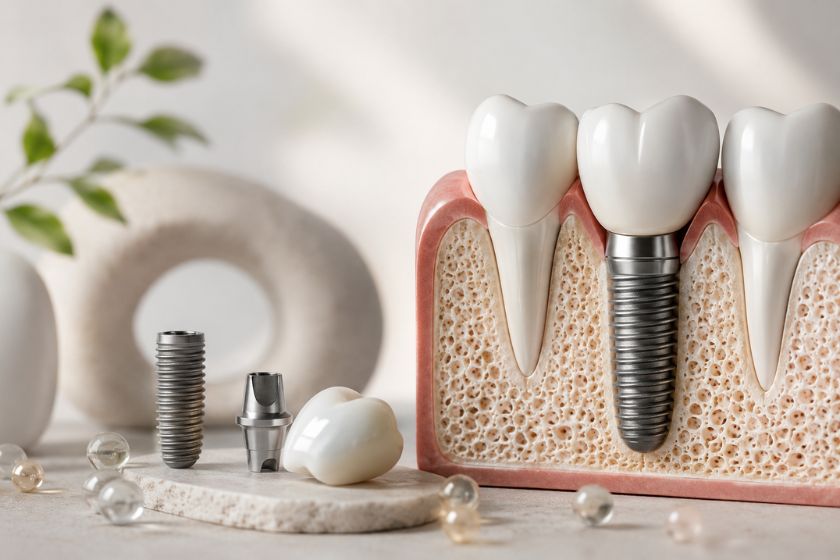
The bone loss This is one of the situations that generates the most doubt when a patient needs to be placed. dental implants. Many people come to the consultation thinking that, because they have little bone, they can no longer have implants or that their case has no solution.
However, today there are different alternatives for evaluating and planning implant treatments, even in complex cases. The key is to perform a accurate diagnosis, study the available bone volume and choose the most suitable option for each patient.
In Doctor Dent, Dental implant treatments are planned individually, using diagnostic technology and digital planning to rigorously assess each case before indicating any procedure.
Why bone may be insufficient before implant placement
The bone surrounding the teeth serves a vital function: it supports the teeth and maintains the stability of the mouth. When a tooth is lost, that area stops receiving the natural stimulus of chewing, and over time, the bone can resorb.
This bone loss It can be greater the longer the time that has passed since the tooth was extracted, especially if the missing tooth has not been replaced.
It can also be caused by periodontal disease, dental infections, trauma, complex extractions or due to prolonged use of removable prostheses that do not transmit forces naturally to the bone.
Therefore, when a The patient wishes to have an implant placed.Yes, it's not enough to assess the visible space in the mouth. It's necessary to study what's happening beneath the gum and how much bone is actually present.
Having little bone does not always mean you cannot have implants
One of the most important ideas is that a lack of bone does not automatically rule out the possibility of implant treatment.
Each case must be assessed individually. Some patients have mild bone loss and can receive implants with proper planning. In other cases, it may be necessary to prepare the area beforehand using bone regeneration techniques or to consider specific alternatives based on the patient's anatomy.
The important thing is not to promise general solutions. Two patients with "little bone" may need completely different treatments depending on the affected area, bone quality, gum condition, bite, and the type of rehabilitation desired.
In implantology, diagnosis is what allows us to differentiate a simple case from a complex case.
3D imaging: a key tool in cases with little bone
When bone loss is suspected, three-dimensional radiological study is essential to accurately plan treatment.
Unlike a conventional X-ray, 3D technology allows for the analysis of bone volume in width, height, and depth. This helps to understand the patient's anatomy in detail, the position of important structures, and the actual possibilities for placing implants safely.
Thanks to this study, the specialist can assess whether there is enough bone, whether regeneration will be necessary, what type of implant could be used, and what the most suitable position would be.
Digital planning allows you to anticipate difficulties, reduce improvisation, and design a more predictable treatment.
When we talk about implants in cases with little bone, seeing accurately before acting makes a significant difference.
Bone regeneration: preparing the ground before the implant
In some patients, it may be necessary to restore some of the lost bone volume before placing a dental implant.
Bone regeneration is a procedure that seeks to increase or improve the available bone in a given area to create more suitable conditions before implant placement.
It may be indicated when the bone is insufficient in width or height, when there has been a previous infection, when tooth loss has gone untreated for a long time, or when the area needs more support to achieve a stable result.
Not all cases require regeneration, but when it is indicated, it can be an important step in improving the safety and predictability of the treatment.
Success depends not only on placing the implant, but also on properly preparing the area where it will be placed.
Breast lift and other techniques in posterior areas
When the bone loss It occurs in the posterior area of the upper jaw; one of the most common situations is that the maxillary sinus is very close to the area where the implant should be placed.
In these cases, it may be necessary to consider specific techniques, such as sinus lifts, which allow for increased bone height in certain patients and create a more suitable base for the implant.
There are also other alternatives depending on the clinical situation, such as implants of specific dimensions, guided planning, or rehabilitative treatments adapted to the amount of bone available.
The choice of one technique over another always depends on the diagnostic study. There is no single solution for all patients, but rather different options that must be selected based on clinical judgment.
Bone quality also matters
When discussing dental implants, people often focus solely on the quantity of bone. However, bone quality is also important.
Having dense, stable bone is not the same as having thinner, fragile, or resorbed bone. Bone quality influences the initial stability of the implant, treatment planning, and healing time.
Therefore, the specialist does not only assess whether "there is enough bone", but also what that bone is like, in what area it is located, what forces it will receive and what type of rehabilitation will be placed afterwards.
A dental implant should not be planned in isolation, but within the context of the mouth, the bite, and the patient's functional and aesthetic needs.
Not all complex cases are resolved in the same way.
In patients with limited bone, planning must be especially careful. In some cases, the implant can be placed after prior preparation of the area. In others, it may be advisable to perform the treatment in stages. And in some patients, it may be necessary to consider different rehabilitation alternatives.
The important thing is that the treatment plan is not based on a standard solution, but on a personalized assessment.
To promise that any patient can get implants without first assessing their individual situation would be inaccurate. Modern implantology offers many possibilities, but these should always be prescribed responsibly and tailored to the specific case.
A good treatment begins with knowing which option is truly viable, safe, and appropriate for each patient.
Clinical experience and precise planning
Implant cases with limited bone require a combination of diagnosis, technology, and clinical expertise.
Technology allows for precise analysis of anatomy, but it is the specialist's judgment that determines which technique to use, when to perform each phase, and how to achieve a functional, stable, and lasting result.
At Doctor Dent, implantology treatments are studied individually to plan every detail and offer solutions tailored to the real needs of each patient.
The goal is not just to place implants, but to do so on a well-diagnosed basis, with proper planning and a long-term vision.
The first step: study the case in detail
The best way to know if you can get dental implants when you have little bone is to have a complete clinical evaluation.
At Doctor Dent, implant treatment is evaluated in a personalized way by our implantology specialist, Dr. José Márquez, who analyzes each case in detail to plan the treatment precisely and assess the most appropriate options based on the available bone, gum, bite and the needs of each patient.
Have you been told you have a small bone structure and want to assess your options?
If you need dental implants and are worried about not having enough bone, the first step is to have a complete study done to understand your actual situation and assess what alternatives exist in your case.
You can book your appointment through our contact or contact the clinic at the 938 11 00 07 or in the 659 428 355. We would be delighted to assist you at our dental clinic in Sitges.