

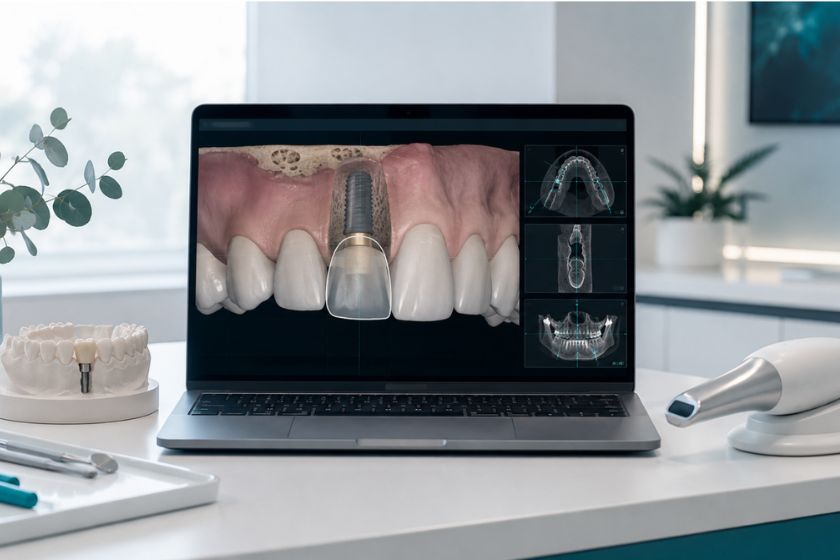
The loss of a front tooth often causes immediate concern, not only because of the functional impact it can have, but also because it affects a very visible area of the mouth. smile.
In these cases, the dental implant treatment It requires particularly careful planning. It's not just about replacing a missing tooth, but about ensuring the result blends naturally into the smile, respecting the harmony of the teeth, gums, and facial profile of the patient.
In Doctor Dent, At your trusted clinic in Sitges, cases of implants in the aesthetic zone are studied from individualized form to plan every detail with precision and deliver a functional, stable, and as natural a result as possible.
When a front tooth is missing, the aesthetic demands are greater.
Not all dental implants have the same degree of complexity. When the missing tooth is located in a posterior area, the priority is usually focused on restoring chewing function and bite stability.
However, when an incisor or canine is missing, the level of requirement The aesthetics are much greater. In these cases, in addition to restoring function, it is essential to ensure the implant's visual integration into the smile.
He color, shape, tooth position, and gum contour These are aspects that must be studied with great precision so that the result does not stand out artificially compared to natural teeth.
It's not just about the implant, but about everything that surrounds it.
In the rehabilitation of an anterior tooth, success does not depend solely on the implant being osteointegrate correctly in the bone. It is also essential that the final restoration looks harmonious within the overall smile.
To achieve this, it is necessary to assess multiple factors that directly influence the final aesthetics of the case:
The gingival profile
One of the most important aspects in the aesthetic area is the gum profile.
The gum tissue surrounding the future implant must maintain an appropriate shape, volume, and height so that the tooth integrates naturally with the adjacent teeth. When this is not properly planned, visible differences may appear in the gum line or in the shape of the soft tissues.
Therefore, in previous implants, not only is the available bone studied, but also the quality and behavior of the gum in that area.
The shape and position of the tooth
In a visible area, small details can make a big difference. The three-dimensional position of the implant directly influences the final crown's shape and how it will relate to the adjacent teeth.
A poorly positioned implant can hinder the creation of a harmonious restoration, even if it is functionally well integrated. Therefore, precise placement is one of the most important factors in this type of treatment.
The relationship with neighboring teeth
When an anterior tooth is missing, the goal is not only to close the space, but to ensure that the new tooth relates in a balanced way to the adjacent natural teeth.
This involves respecting proportions, contours, transition lines and symmetries so that the implant does not stand out, but rather integrates visually and naturally into the patient's smile.
Digital planning: a key tool in aesthetic cases
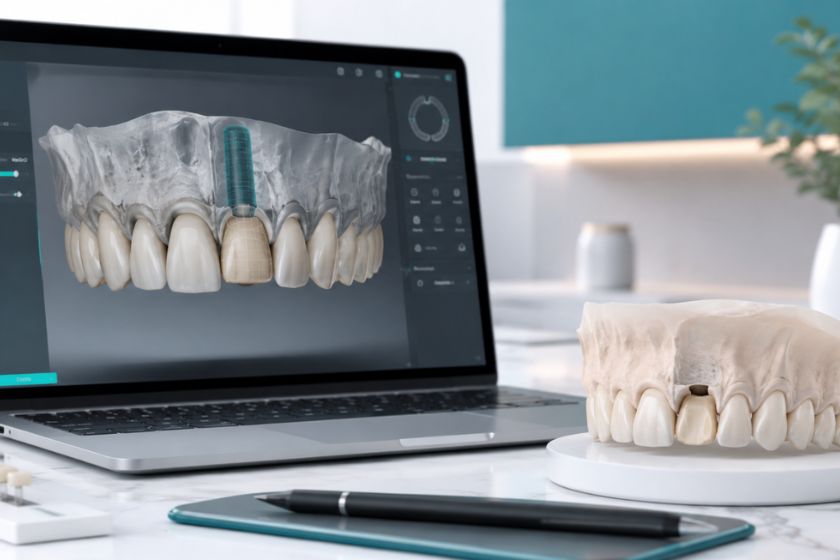
In dental implants in the anterior region, prior planning is of particular importance.
Through clinical study, radiological tests and three-dimensional digital planning, it is possible to accurately analyze the patient's anatomy, the ideal implant position and the anatomical structures that must be respected.
This planning allows for anticipating the treatment, improving the safety of the procedure, and designing the implant placement considering not only its stability but also the final aesthetic result.
When it comes to implants in aesthetic areas, improvisation has no place. The more precise the planning, the more predictable the result tends to be.
The importance of provisionalization
In many cases, especially when it comes to an anterior tooth, the provisional phase plays a fundamental role in the treatment.
Provisionalization allows for the placement of a temporary restoration that not only addresses an immediate aesthetic need, but also helps guide the shape of the soft tissues during the healing process.
This is especially useful for shaping the gum tissue and promoting a more natural transition to the final restoration. In other words, it's not simply about "placing a temporary restoration," but about using this phase as an active part of the aesthetic planning of the case.
In well-planned treatments, provisionalization can be crucial to achieving a more harmonious final result.
Each case requires an individualized assessment
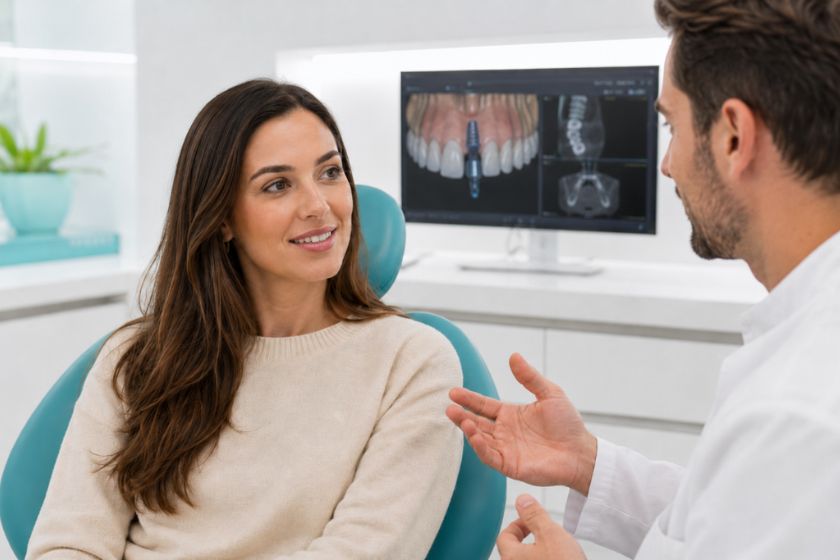
Not all patients present the same clinical situation when they lose a front tooth. The condition of the bone, the volume of the gum tissue, the reason for the tooth loss, the position of the adjacent teeth, and the time elapsed since the tooth's absence are all factors that can completely change the treatment plan.
In some cases, the implant can be placed under very favorable conditions. In others, it may be necessary to prepare the area beforehand or carefully plan each phase to optimize the result.
Therefore, before prescribing treatment, it is essential to perform a complete and personalized diagnosis.
Clinical experience and precision: two fundamental keys
Implants in the aesthetic zone require a combination of rigorous diagnosis, precise planning, and clinical judgment.
Simply replacing the tooth from a functional standpoint is not enough. It is also necessary to understand how the tissues behave, how the implant's position influences the final aesthetics, and what clinical decisions help achieve a natural integration into the smile.
Therefore, this type of case requires meticulous attention to detail and very careful planning from the very beginning.
The first step: study the case in detail
The best way to assess what treatment a missing front tooth needs is to perform a complete clinical examination and an accurate diagnostic study.
At Doctor Dent, implant treatment is evaluated in a personalized way by our implantology specialist, Dr. José Márquez, who analyzes each case in detail to plan the treatment precisely and offer solutions adapted to each patient.
Are you missing a front tooth and want to have your case assessed?
If you have lost a tooth in a visible area of your smile and want to know what options exist to rehabilitate it aesthetically and functionally, the first step is to carry out a complete clinical evaluation.
You can book your appointment through our contact or contact the clinic at the 938 11 00 07 or in the 659 428 355. We would be delighted to assist you at our dental clinic in Sitges.