

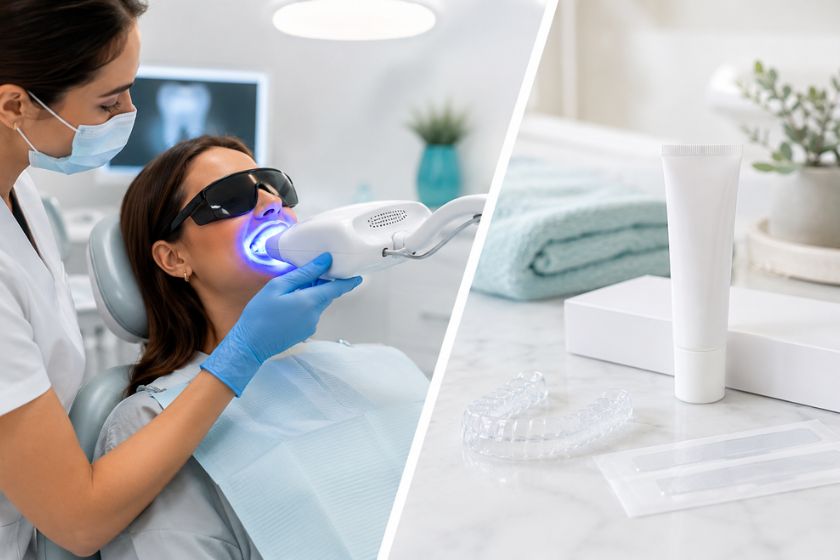
More and more people want to improve their color of their teeth and regain a brighter smile. It is a very common concern, especially when stains appear, progressive darkening occurs, or the tooth tone is no longer as uniform as before.
Given this situation, many people wonder if it is better to resort to a professional teeth whitening or try household products first.
And although both options aim to improve the appearance of tooth color, they do not offer the same thing in terms of control, safety, or stability of the result.
In Doctor Dent, Teeth whitening is always assessed individually, after a clinical diagnosis has been made to determine the most appropriate treatment based on the condition of the teeth, gums, and the expectations of each patient.
Not everything that whitens works the same.
Professional teeth whitening uses bleaching agents in higher concentrations and, above all, is done after a prior diagnosis and with gum protection, sensitivity control and clinical follow-up.
That's why it usually achieves a more noticeable, predictable, and stable color change than over-the-counter products. Furthermore, a specialist can assess whether the problem is truly related to color or if there are cavities, fillings, wear, or inflamed gums that should be treated first.
Homemade products such as strips, pastes, or over-the-counter kits usually contain a lower concentration of bleaching agents or only act on surface stains, so the result is usually more subtle, slower, and less controllable.
They can help in mild cases, but they do not usually match the intensity or precision of professional treatment.
The other big difference is the real security.
Both professional and at-home teeth whitening can cause temporary sensitivity, but with clinical supervision, this sensitivity can be prevented, adjusted, and better controlled.
In contrast, the improper or frequent use of whitening products has been associated with gingival irritation, sensitivity and, if abused, even damage to enamel and gums.
The prior diagnosis: a fundamental difference
One of the main differences between professional teeth whitening and home products is that clinical treatment always starts with a prior assessment.
Before recommending teeth whitening, the dentist examines the condition of the mouth to check for any problems. cavities, leakage, tooth wear, gingival inflammation, hypersensitivity prior or any other circumstance that should be taken into account before starting treatment.
This step is fundamental, because it's not just about whitening, but about doing it in safe and suitable conditions for each patient.
Without that diagnosis, cosmetic treatment can be started on teeth or gums that are not in the ideal condition, increasing the risk of discomfort or unsatisfactory results.
What does clinical control contribute to professional teeth whitening?
Teeth whitening performed under professional supervision is not simply about applying a stronger product. Its main value lies in the clinical monitoring throughout the entire process.
Individual case assessment
Each patient presents unique characteristics: base tooth color, type of staining, enamel condition, sensitivity level, and aesthetic expectations. Therefore, treatment must be tailored to each individual case.
The professional assesses which technique may be most suitable, what intensity should be used, and how to plan the treatment to achieve a harmonious and safe result.
Monitoring of tooth sensitivity
One of the aspects that most concerns patients is sensitivity. And it's a logical concern, because some whitening treatments can cause it temporarily. The difference is that, in a professional treatment, this sensitivity is monitored and taken into account from the beginning.
The dentist can adjust the guidelines, assess the patient's tolerance, and apply measures to minimize discomfort.
This clinical support allows the treatment to be carried out more safely and with better tolerance.
Monitoring the result
He teeth whitening It should not be valued solely on the initial color change, but also on how the result evolves.
When the treatment is supervised, the process can be closely monitored, the tooth's response can be checked, and it can be assessed whether the result achieved is stable, natural, and consistent with the patient's smile.
What limitations might homemade products have?
Household products can be appealing because they are affordable and easy to buy. However, it's important to understand that not all of them offer the same level of effectiveness or the same degree of control.
In many cases, their effect is limited to superficial staining or subtle changes, and they don't always allow for predictable changes to the actual tooth color. Furthermore, without prior diagnosis, patients may use them without knowing if they have sensitivity, wear, or other pre-existing problems that should be assessed beforehand.
This doesn't mean they should be discredited altogether, but it is important not to equate them with clinically supervised treatment. They are different options, with different scopes and very different levels of control.
Safety depends not only on the product, but also on how and when it is used.
One of the most common mistakes when discussing teeth whitening is thinking that safety depends solely on the product used. In reality, it also depends on the prior diagnosis, the indication for the treatment, the application method, and the monitoring of the treatment.
Even a seemingly simple product may not be the best option if the patient has marked sensitivity, visible restorations, gingival inflammation, or enamel alterations.
Therefore, professional supervision not only seeks to obtain a better aesthetic result, but also to reduce unnecessary risks and adapt the treatment to the real conditions of the mouth.
The stability of the result also matters
Many people focus their attention on how much their teeth are whitened, but they don't always think about how long that result lasts and under what conditions it was achieved.
In a professional treatment, the goal is not only to lighten the color, but to do so in a controlled manner and according to clinical criteria. This helps achieve a more predictable, balanced result that is better integrated into the smile.
In addition, the professional can guide the patient on maintenance, habits that influence color, and realistic expectations, which is essential to preserve the result in the medium and long term.
The first step: a professional assessment
The best way to find out which option might be right for you is to have a full clinical evaluation.
At Doctor Dent, the Dr. Corina N. Bratu, specialist in aesthetics and comprehensive oral rehabilitation As the clinic's medical director, she studies each case individually to assess the condition of the teeth, gums, and the characteristics of the smile before recommending any aesthetic treatment.
This approach allows us to recommend the safest and most appropriate option for each patient, always with the aim of achieving a natural, harmonious and clinically sound result.
Do you want to improve the color of your teeth safely?
If you are thinking about teeth whitening and would like to know which option might be best for you, the first step is to have a personalized assessment.
You can book your appointment through our contact or contact the clinic at the 938 11 00 07 or in the 659 428 355. We would be delighted to assist you at our dental clinic in Sitges.