

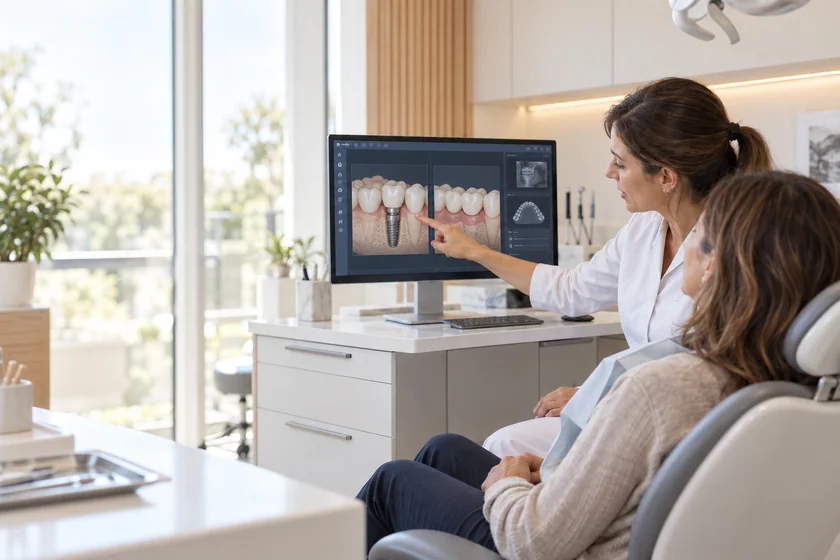
When a tooth is lost, replacing it is not just a matter of aesthetics. The gap can affect chewing, cause adjacent teeth to shift, and alter the balance of the bite.
In Doctor Dent, dental clinic in Sitges, One of the most common questions among patients is whether a dental bridge or an implant is more suitable. Both options allow for the replacement of a missing tooth, but they work differently and are not indicated in the same situations.
The choice should be made after evaluating the condition of neighboring teeth, available bone, gum health, bite, and the needs of each patient.
What is a dental bridge?
A dental bridge is a fixed prosthesis that fills the gap left by a missing tooth. In its conventional form, it rests on the teeth located on either side of the gap.
To place it, it is usually necessary to prepare these teeth and cover them with crowns. The artificial tooth that replaces the missing tooth is then placed between the crowns.
It may be a suitable alternative when:
- The neighboring teeth already have crowns or significant restorations.
- Those teeth need to be restored.
- The patient cannot or does not wish to undergo surgery.
- The condition of the bone makes it difficult to place an implant.
- A permanent rehabilitation is sought within a shorter timeframe.
The bridge is not placed on the bone, but obtains its stability from the teeth that support it.
What is a dental implant?
An implant is a structure placed in the jawbone to replace the root of a missing tooth. A crown, designed to restore the tooth's function and appearance, is then attached to it.
Unlike a conventional bridge, an implant allows you to replace the tooth without wearing down neighboring parts. Therefore, it is usually especially valued when the teeth on both sides of the space are healthy.
At Doctor Dent we work with treatments of Dental implants and oral rehabilitation planned individually.
Preservation of neighboring teeth
This is one of the main differences between the two options.
To place a conventional bridge, it is necessary to prepare the teeth that will act as abutments. Even if they are healthy, they must be modified to support the prosthesis.
The implant works independently and It allows adjacent pieces to remain intact.. However, it requires surgical intervention and an adequate amount of bone.
When the adjacent teeth are healthy, an implant may be the most conservative option. If they are already heavily restored or require crowns, a bridge may be a suitable option as part of a more comprehensive rehabilitation.
Which one offers greater stability?
Both bridges and implants are fixed solutions and can provide comfortable chewing when properly designed.
The implant transmits forces directly to the bone and does not depend on other teeth for support. The bridge, on the other hand, distributes the load among the abutment teeth.
Therefore, before placing a bridge, it is essential to check that those teeth have a sufficient structure, stable roots, and healthy gums. If one of the pillars has a problem, the entire prosthesis may be compromised.
Differences in maintenance
Neither alternative is without its precautions.
In a bridge, hygiene should also be performed underneath the tooth that occupies the space of the missing tooth. For this, specific dental floss, interproximal brushes, or irrigators can be used.
In the case of an implant, it is necessary to carefully clean the crown and the surrounding gum tissue. Plaque buildup can cause inflammation and affect the tissues supporting the implant.
Good daily hygiene and regular check-ups are essential for the duration of both treatments. If gum disease is present, it should be treated before undergoing rehabilitation. You can consult our treatment options for periodontics.
Which option offers a more aesthetically pleasing result?
Both solutions can be seamlessly integrated with the rest of the smile. The result depends on the planning, the materials used, and the condition of the gums.
In visible areas, implant placement requires careful monitoring of gum position and bone volume. In certain cases, additional treatments may be necessary to achieve a harmonious contour.
A bridge can also offer a very natural aesthetic, especially when the neighboring teeth already need to be restored. There is no aesthetically superior option in all cases.
Which one lasts longer?
It is not possible to establish an exact duration. The evolution of a bridge or implant depends on factors such as:
- Oral hygiene.
- Gum health.
- The state of the bone.
- Tobacco.
- Bruxism.
- The quality of the teeth that support the bridge.
- Assistance with inspections and maintenance.
Implants can offer a very long-lasting solution, but they are not immune to complications. Bridges can also last for many years if the abutment teeth remain healthy.
Rather than seeking a "for life" solution, it is advisable to choose the alternative with the best prognosis for each individual mouth.
So, dental bridge or implant?
In general:
- An implant may be recommended. When the neighboring teeth are healthy, there is sufficient bone and the patient can undergo the procedure.
- The bridge could be a good option when the adjacent teeth already need crowns, there are limitations to placing an implant, or surgery is to be avoided.
- If there is bone loss, periodontal disease, bruxism, or other conditions, these will need to be studied before making a decision.
The choice shouldn't depend solely on price or speed. You should also consider the preservation of natural teeth, ease of maintenance, and long-term prognosis.
Personalized assessment at Doctor Dent
At Doctor Dent, the study of implant treatments is carried out by Dr. José Daniel Márquez Gámez, oral surgeon and implantologist, member number COEC 8259.
Dr. Márquez has extensive training and experience in oral surgery, advanced implantology and planning of complex implant treatments. Before recommending an implant, study the volume and quality of the bone, the condition of the gums, the bite, and the position of the adjacent teeth.
When an implant is not the most suitable alternative, the case can be approached from a multidisciplinary perspective to assess other rehabilitation options, such as a dental bridge.
The decision is not about choosing the most modern treatment, but the one that offers the best prognosis and allows the tooth to be recovered in the most conservative, stable, and safe way.
If you have lost a tooth, you can request a personalized assessment with our team of specialists o Make an appointment at Doctor Dent.
You can also call us at 938 110 007 or write to us on WhatsApp at 659 428 355. We will see you at our dental clinic in Sitges.