

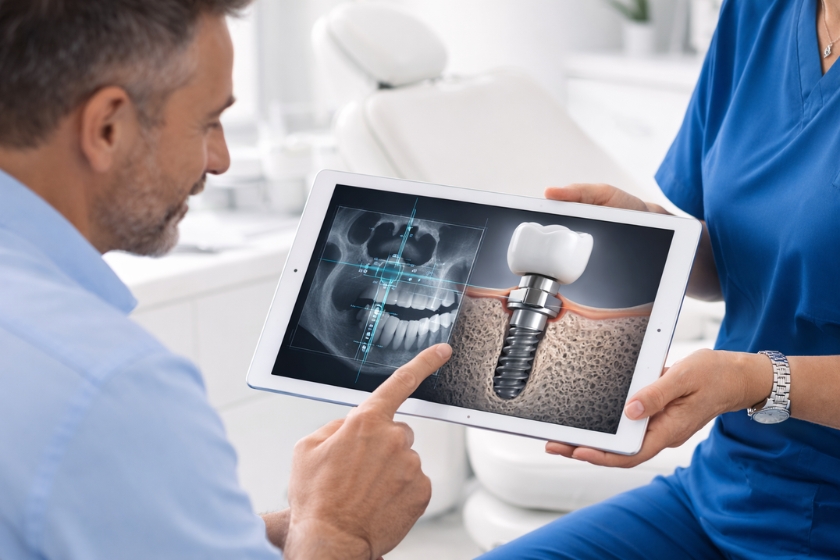
Dental implants have become one of the most effective and long-lasting solutions for replacing missing teeth. However, many people considering this treatment ask themselves the same question: Am I a good candidate?
The need for an implant is not solely determined by having lost a tooth. Before recommending this treatment, the specialist performs a complete evaluation of the mouth to assess various factors that influence the procedure's success.
In Doctor Dent, he treatment with implants is evaluated individually by our implantology specialist, Dr. José Márquez, which analyzes each case in detail to plan treatment accurately and safely.
What is a dental implant?
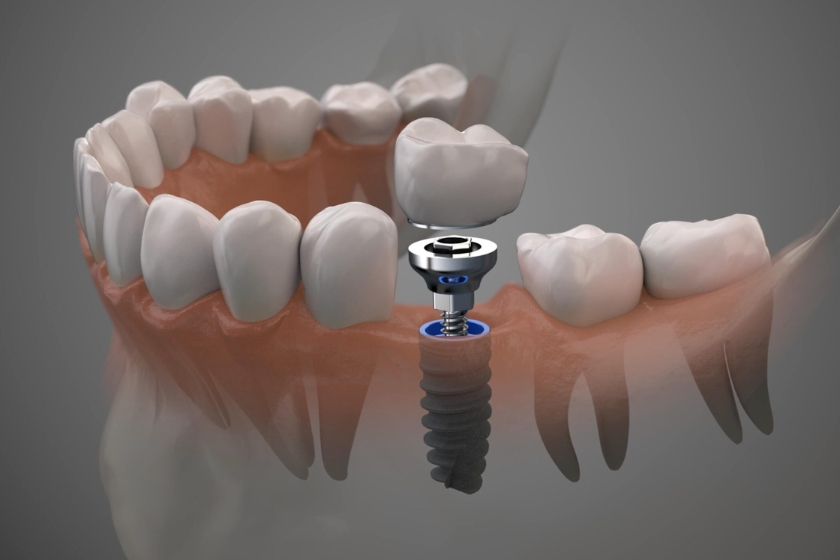
A dental implant is an artificial root, usually made of titanium, that is placed in the jawbone to replace the root of a missing tooth. A dental crown, designed to restore the shape, function, and appearance of a natural tooth, is then placed on top of this implant.
This type of treatment allows replace one or more missing teeth without needing to support the prosthesis on the neighboring teeth, which makes it a very conservative solution for the dental structure.
Dental implants integrate into the bone through a biological process called osseointegration, which allows the implant to be firmly anchored and able to withstand the forces of chewing in a stable manner.
When treatment is properly planned, implants offer a functional, aesthetic and long-lasting solution to restore your smile and the ability to chew normally.
Not all cases are the same: the importance of an individual assessment
Each patient presents a different situation. Therefore, before placing a dental implant, it is essential to carry out a diagnostic study to determine the condition of the bone, gums, and adjacent teeth.
This analysis allows us to determine whether the implant can be placed directly or if it is necessary to perform some treatment beforehand to prepare the area.
In many cases, proper planning is the key to achieving stable and lasting results.
Factors that are considered before placing a dental implant
During the initial consultation, the specialist analyzes different aspects that help determine if the patient is a good candidate for implants.
Patient's age
One of the most frequent questions is whether there is a minimum or maximum age for placing implants. In reality, the determining factor is not age, but the state of bone development.
Dental implants are usually placed once bone growth has finished, which generally occurs by the end of adolescence. In adults, even at advanced ages, the treatment can be performed if the oral conditions are suitable.
Bone quality and quantity
For a dental implant to be stable, it needs to integrate properly with the maxillary or mandibular bone. Therefore, it is essential to assess whether there is sufficient bone in the area where the implant will be placed.
Some patients may experience bone loss after a tooth extraction. In these cases, there are techniques that allow bone regeneration before implant placement.
Gum condition and periodontal health
Gum health is another essential factor. If the patient has periodontal disease, it will need to be treated before starting implant treatment.
Good periodontal health control helps reduce the risk of complications and promotes long-term implant stability.
Digital treatment planning.
Today, technology plays a fundamental role in the planning of implant treatments.
Through radiological studies and three-dimensional digital planning, it is possible to analyze with great precision the patient's anatomy, the position of the bone, the nerves, and the neighboring teeth.
This planning allows the implant to be placed in the most suitable position, improves the safety of the procedure, and allows the final result to be predicted before starting the treatment.
Osseointegration: the key factor for the success of an implant
One of the most important aspects of dental implant treatment is the osseointegration, That is, the process by which the implant integrates stably into the bone.
The implant acts as an artificial titanium root that must fuse with the maxillary or mandibular bone to subsequently support the dental crown. This biological process is what allows the implant to function like a natural tooth.
For osseointegration to occur correctly, several clinical conditions are essential: good bone quality, correct implant position planning, and a healthy periodontal environment.
Furthermore, digital treatment planning allows the implant to be placed with great precision, respecting the anatomical structures and optimizing the conditions for this integration to be stable and long-lasting.
When the diagnosis is correct and the procedure is performed under rigorous clinical criteria, dental implants can offer very predictable and stable long-term results.
When the implant is part of a broader treatment plan
In some cases, the placement of an implant is not an isolated treatment, but rather part of a more complete rehabilitation.
It may be necessary to combine the implant with other prior treatments, such as orthodontics, bone regeneration or prosthetic rehabilitation, with the aim of properly restoring the function and aesthetics of the smile.
Therefore, the initial evaluation is a fundamental step in designing a treatment plan appropriate for each patient.
The first step: an accurate diagnosis
The best way to find out if you are a candidate for a dental implant is to have a complete clinical evaluation.
At Doctor Dent, implantologist Dr. José Márquez studies each case individually, using advanced diagnostic tools to plan treatment precisely and offer solutions tailored to each patient.
Do you want to know if you are a candidate for a dental implant?
If you have lost one or more teeth and want to know if implant treatment may be suitable for your case, the first step is to have a complete clinical evaluation.
You can book your appointment through our contact or contact the clinic at the 938 11 00 07 or in the 659 42 83 55.
We will be happy to assist you at Doctor Dent, in Sitges (Barcelona).