

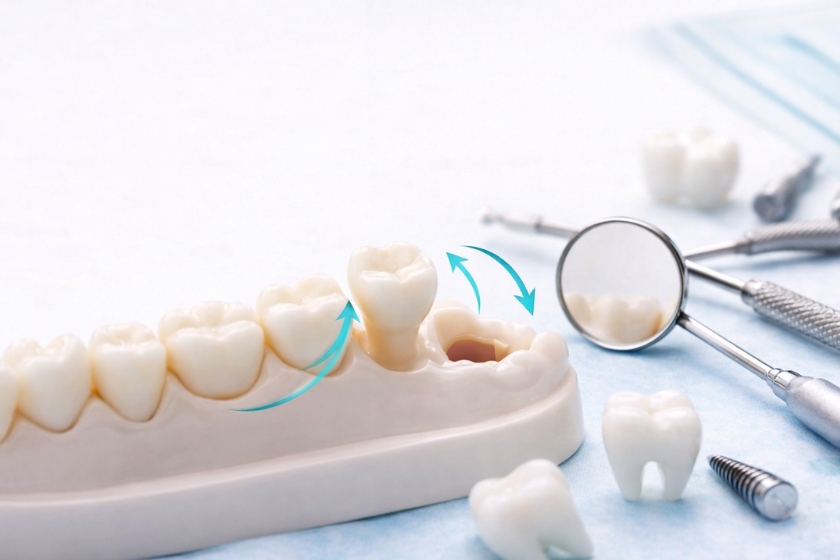
Losing a tooth It does not always cause immediate concern, especially if it is not located in a visible area of the smile.
Many people can go months or even years without replacing it, thinking that, if they feel no pain or continue chewing relatively normally, There is no real problem.
However, the absence of a tooth It doesn't just affect the space that's been left empty. Over time, this loss can cause progressive changes in the bite, the position of the teeth, and the bone that supported the tooth.
In Doctor Dent, Your trusted dental clinic in Sitges, We study each case individually to assess how the loss of a tooth affects oral function and what treatment may be most appropriate to restore long-term oral stability.
A missing tooth doesn't just affect aesthetics
When a back tooth is lost, it's common to think that, since it's not visible when smiling, its absence isn't very important. However, molars They fulfill an essential function in chewing and in the balance of the bite.
Each tooth maintains a specific relationship with its neighboring teeth and with its counterpart in the opposite arch. When a tooth is missing, this balance begins to shift. Although the patient may not always notice it at first, The mouth begins to adapt to that absence, And that adaptation is not always beneficial.
Therefore, replacing a missing tooth is not only an aesthetic issue, but also a functional and structural one.
What happens in the mouth when a missing tooth is not replaced?
The mouth functions as a system in which all the parts are interconnected. When a tooth is lost and not replaced, various changes can occur over time.
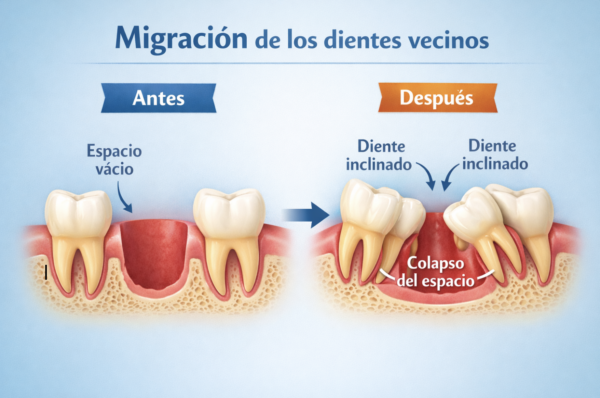
Migration of neighboring teeth
One of the most frequent effects is displacement of adjacent teeth towards the empty space. By losing the point of contact they had with the missing tooth, these teeth can gradually tilt.
This movement can alter tooth alignment and make hygiene more difficult in the area, also favoring the accumulation of plaque and food debris.
Extrusion of the opposing tooth
In addition to the displacement of neighboring teeth, there can also be what is known as extrusion of the antagonist tooth, that is, the tooth located in the opposite arch.
If a molar loses contact with the opposing tooth, it can go descending or erupting more than usual Over time, this can happen as it loses proper functional support. This also alters the relationship between the two dental arches and can interfere with the bite.
Bite abnormalities
When the position of the teeth changes, the way you chew can also change. The patient may begin to put more weight on one side of their mouth, unconsciously change their chewing patterns, or notice that their bite no longer fits together the same way as before.
These alterations can lead to overloads on other parts dental, premature wear and tear or muscle and joint discomfort in some cases.
Progressive bone loss after extraction
One of the most important changes that occur after losing a tooth is the bone resorption.
The bone surrounding a tooth is maintained in part by the functional stimulus it receives during chewing. When the tooth root disappears, this stimulus ceases, and the bone in the area can begin to gradually lose volume. This process is not always visible to the naked eye, but it has significant clinical relevance.
The longer the tooth remains unreplaced, the more likely the bone is to shrink in width or height, which can complicate future treatments.
In some cases, when bone loss is significant, it may be necessary to perform prior regeneration procedures in order to properly rehabilitate the area.
There isn't always pain, but there can be consequences.
One of the reasons many people delay treatment is that they don't feel any pain. And it's true that a missing tooth doesn't always cause immediate discomfort.
However, The absence of pain does not mean that changes are not taking place.. Many of the consequences of not replacing a missing tooth are progressive and silent. They develop gradually and are often detected only when they have already caused a major alteration in the bite or the condition of the surrounding teeth.
Therefore, after an extraction or the loss of a tooth, it is important to carry out an evaluation to study what is the best way to replace it and when it is convenient to do so.
The importance of planning the replacement of the part
Not all patients present the same clinical situation. time elapsed since the loss, the condition of the gums, the amount of bone available, or the position of neighboring teeth They directly influence treatment planning.
Therefore, before deciding how to replace a missing tooth, an accurate diagnosis is essential. Clinical and radiological examination allows for an assessment of the area's condition and the design of a treatment tailored to each individual case.
Acting in time allows for simpler and more predictable treatments.
Dental implants as a solution to replace a missing tooth
One of the most effective options for replacing a missing tooth is the dental implant.
The implant allows to replace the root and crown of the tooth lost without needing to lean on neighboring teeth. This helps to to restore chewing function, maintain bite stability, and better preserve bone structure of the area.
Furthermore, when the treatment is planned correctly, the implant can integrate stably and offer a functional, long-lasting, and very natural solution.
In Doctor Dent, The implant treatment is assessed on a personalized basis by Our implantology specialist, Dr. José Márquez, which studies each case in detail to plan the best solution according to the needs of each patient.
The first step: assess your case individually
If you have lost a tooth, even if time has passed and you don't notice any discomfort, it is advisable to have a check-up to assess how that absence is affecting your mouth.
In Doctor Dent We study each case individually to analyze the condition of the bite, adjacent teeth, and bone, in order to recommend the most appropriate treatment.
Have you lost a tooth and want to know if you should replace it?
If you want to know what consequences not replacing a missing tooth might have in your case, or if you want to consider options such as... dental implants, The first step is to perform a complete clinical assessment.
You can book your appointment through our contact or contact the clinic at the 938 11 00 07 or in the 659 428 355.